


We talked about the problem in part one.
Now let’s talk about what a properly connected wholesale operation actually looks like.
Because the issue isn’t labour. It isn’t your team. It isn’t even your growth.
The issue is the lack of a unified operational system.
What Happens When Everything Is Connected
Instead of:
- Orders coming from different channels
- The warehouse is guessing what to pick
- Drivers waiting for instructions
- Finance chasing payments
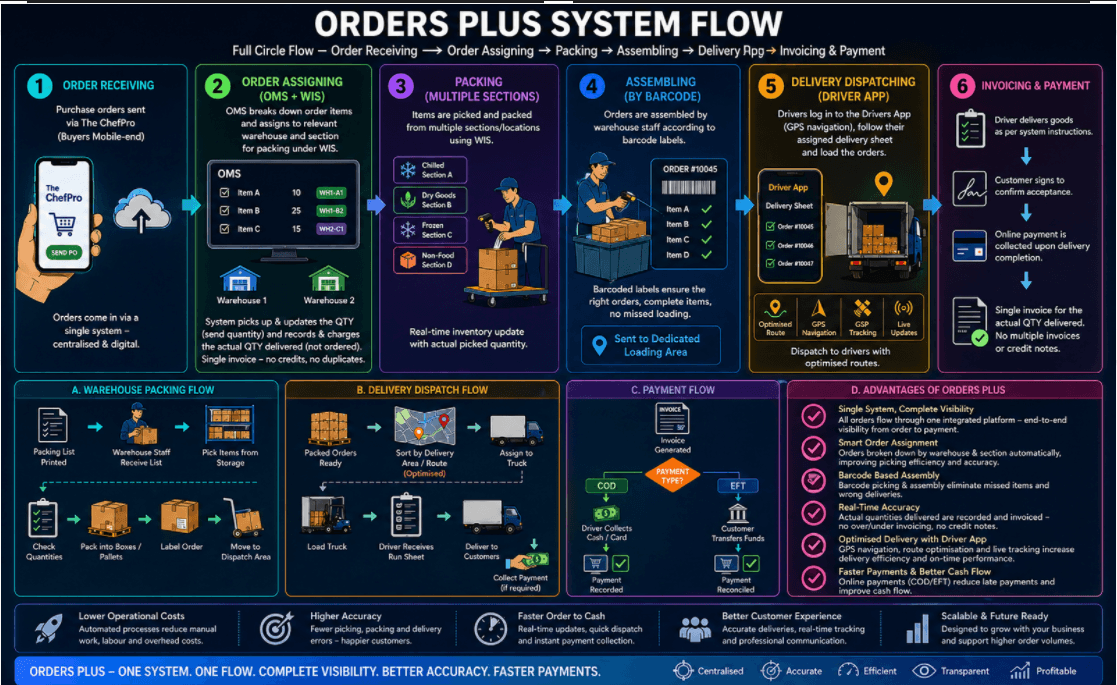
You get one continuous operational flow:
A Single System. One Flow. End-to-End Visibility.
Here’s how a modern wholesale operation should run:
1. Order Comes In — Already Structured
No more WhatsApp. No more SMS. No more phone call orders and manual recording.
Orders are placed through a centralised system:
- Standardised format
- Clean item breakdown
- No missing information
The system already knows what needs to happen next.
2. Smart Order Assignment: OMS + WMS
Instead of manual sorting:
- Orders are automatically split
- Assigned to the correct warehouse
- Directed to the right picking and packing zones
No confusion. No delays. No double handling.
3. Multi-Section Picking: Real Warehouse Logic
Your warehouse isn’t one space — it’s many:
- Chilled
- Frozen
- Loose and pack
- Dry
- Non-food
Orders are picked simultaneously across sections.
Faster picking. Higher accuracy. Less labour pressure.
4. Barcode-Based Assembly: Zero Guesswork
Every order is assembled using barcode verification:
- Right items
- Right quantities
- Right order
No missing items. No wrong deliveries.
5. Delivery Dispatch That Actually Works
Drivers don’t wait around.
They get:
- Designated loading areas
- Pre-assigned delivery routes
- GPS navigation
- Real-time updates
Dispatch becomes a system — not a daily firefight.
6. Invoice & Payment — Automatically Aligned
This is where most wholesalers bleed money.
Instead, you get:
- Invoices generated from the actual delivered quantity
- No over-invoicing or under-invoicing
- No reconciliation chaos
Payment options include:
- COD
- EFT
- Online payment
Faster cash collection. Cleaner books.
What This Changes Operationally
Let’s be blunt.
This isn’t “efficiency improvement.” This is operational transformation.
Before
- Staff are constantly fixing mistakes
- Managers are firefighting daily
- Finance is chasing numbers that don’t match
- Growth creates more chaos
After
- Orders flow automatically
- The warehouse works with structure
- Delivery runs on schedule
- Finance becomes predictable
Growth no longer breaks the business.
The Real Business Impact
Lower Operational Costs
Less manual coordination. Less wasted labour.
Higher Accuracy
Fewer errors mean fewer complaints and stronger customer retention.
Faster Order-to-Cash Cycle
You get paid quicker. Cash flow improves immediately.
Delivery Efficiency
Optimised routes reduce time, fuel costs, and delays.
Scalable Operations
You can grow volume without increasing chaos.
The Hard Truth
Most wholesalers don’t have a labour problem.
They have a system problem disguised as a labour problem.
And until that’s fixed:
- Hiring more people won’t help
- Working harder won’t fix it
- Growth will only make it worse
Where Orders Plus Comes In
At Orders Plus, we built the system around one principle:
Wholesale operations should run as a single continuous flow — not as disconnected steps.
From:
- Order receiving
- Warehouse execution
- Delivery dispatch
- Payment collection
Everything is connected.
Final Thought
If your business depends on:
- Spreadsheets
- Phone calls
- Manual coordination
Then you don’t have a system.
You have a temporary workaround that won’t scale.
In our next step, we’ll show you exactly how this system can be applied to your current operation — without disrupting your business.
Ready to See How It Works in Your Business?
Visit ORDERSPLUS.COM.AU and request an online demo.