


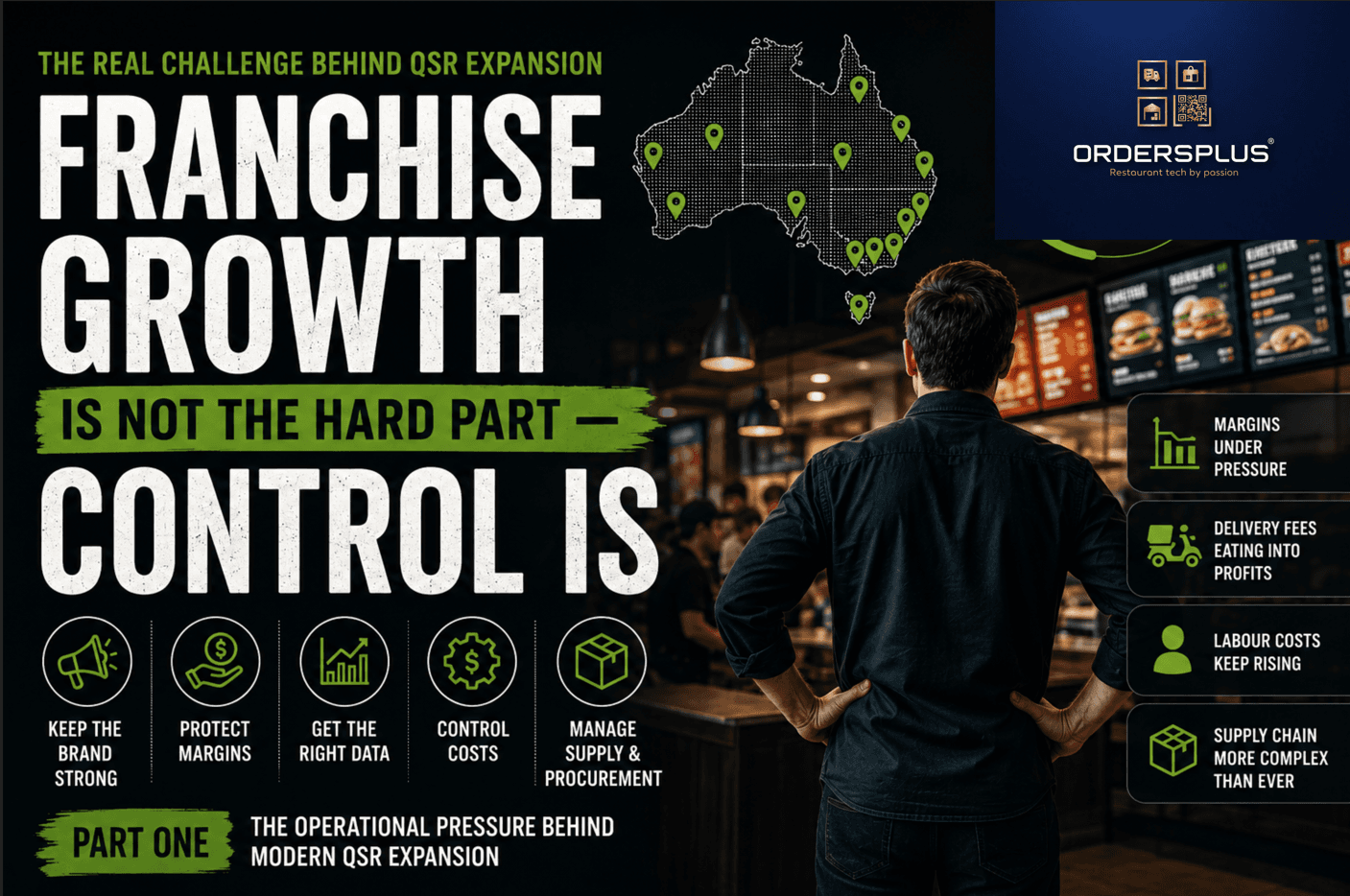
Part One: The Operational Pressure Behind Modern QSR Expansion
At first glance, Australia’s QSR sector appears to be thriving.
New stores continue to open.
Franchise groups continue to expand.
Consumer demand for convenience remains strong.
Digital ordering continues to grow rapidly.
Industry reports estimate the Australian fast-food and takeaway sector to be worth close to $30 billion annually — and still growing.
But beneath the surface, a very different operational reality is emerging.
For modern franchise groups, growth is no longer the hardest challenge.
Control is.
The moment a QSR brand begins scaling beyond a handful of stores, the business fundamentally changes.
The challenge is no longer simply:
“How do we open more locations?”
The real challenge becomes:
“How do we maintain operational consistency, protect margins, and preserve brand value across an expanding network?”
And that pressure is increasing across almost every area of franchise operations.
Brand Growth Creates Operational Complexity
Consumers experience a franchise brand as one business.
But operationally, franchise groups are managing dozens — sometimes hundreds — of independent moving parts simultaneously.
Every new location introduces:
- New staff
- New local competition
- New labour challenges
- New supply-chain variables
- New operational inconsistencies
- New customer expectations
At the same time, the franchisor must continue protecting:
- Brand consistency
- Product quality
- Pricing strategies
- Customer experience
- Marketing performance
- Franchise profitability
That balancing act becomes increasingly difficult as networks expand.
Because franchise growth magnifies operational weaknesses.
The Margin Leakage Problem
One of the biggest pressures facing modern QSR groups is margin leakage through third-party delivery platforms.
Platforms like Uber Eats and DoorDash have become deeply embedded in consumer behaviour.
For many operators, they are no longer optional.
But while these platforms generate sales volume, they also introduce significant operational trade-offs:
- High commission structures
- Reduced customer ownership
- Lower net margins
- Pricing pressure
- Increased operational dependency
In some cases, operators report delivery platform commissions reaching 25%–35% per order.
That creates a dangerous long-term dynamic for franchise groups.
Because revenue growth does not always translate into profitability growth.
A franchise network can appear busy on the surface while margins quietly deteriorate beneath the surface.
And perhaps even more importantly:
The customer relationship increasingly belongs to the platform — not the brand.
This is why more franchise groups are now investing heavily in:
- Direct online ordering
- Loyalty ecosystems
- Mobile apps
- Gift cards
- Customer engagement platforms
Not simply for convenience.
But to regain operational control.
Pricing Is No Longer a Simple Decision
Pricing strategy has also become significantly more complicated.
Modern franchise groups are now balancing:
- Rising labour costs
- Ingredient inflation
- Supplier price fluctuations
- Delivery platform commissions
- Local market competition
- Consumer price sensitivity
At the same time, the franchisor must maintain pricing consistency across the network while still allowing enough flexibility for local market conditions.
That creates enormous operational pressure.
Because menu pricing is no longer just a marketing decision.
It has become a margin-management exercise.
A mature franchise operation must constantly evaluate:
- Food cost performance
- Menu engineering
- Product profitability
- Promotional effectiveness
- Contribution margins
- Customer purchasing behaviour
Without accurate operational visibility, pricing decisions become reactive rather than strategic.
Growth Without Visibility Creates Risk
As franchise groups scale, one of the biggest hidden problems is operational visibility.
Because many franchise systems still operate across disconnected platforms:
- POS systems
- Labour systems
- Delivery platforms
- Inventory tools
- Supplier portals
- Reporting spreadsheets
The result is fragmented operational intelligence.
The head office may receive reports.
But reports alone do not create real-time operational control.
And without visibility, franchise groups struggle to answer critical questions:
- Which locations are genuinely profitable?
- Which stores are underperforming operationally?
- Where are labour costs drifting?
- Which menu items are driving margin erosion?
- Which promotions are actually producing profitable growth?
- How consistent is operational execution across the network?
The larger the franchise network becomes, the more dangerous these blind spots become.
Because operational inconsistency compounds at scale.
The Industry Is Evolving
The QSR industry is no longer competing solely on food quality or store count.
Modern franchise groups are increasingly competing on:
- Operational efficiency
- Data visibility
- Supply-chain coordination
- Customer ownership
- Margin protection
- Speed of decision-making
The strongest franchise systems are beginning to operate less like traditional restaurant groups — and more like connected operational ecosystems.
And that shift is only accelerating.
Because in modern QSR operations:
Growth attracts attention.
But operational control determines sustainability.
The strongest franchise systems are beginning to operate less like traditional restaurant groups — and more like connected operational ecosystems.
And that shift is only accelerating.
Because in modern QSR operations, Growth attracts attention. But operational control determines sustainability.
Part Two:
In the next article, we’ll explore why connected operations, labour visibility, procurement control, and centralised operational infrastructure are becoming critical for modern franchise groups trying to scale sustainably.