

From Brunch Queue to Retail Sales: The Missed Opportunity Inside Modern Precincts
The Queue Outside the Café Is Not Dead Time. It Is Untapped Retail Demand.
In my previous article, I raised a question about Australia’s premium retail precincts:
Who really owns the customer journey?
That article came from a personal family visit to one of Sydney’s well-known shopping and entertainment precincts. The centre itself was world-class. The retail mix was strong. The food, entertainment, parking, and lifestyle offerings were all there.
But from a customer journey perspective, something important was missing.
The precinct had the traffic.
The tenants had the offers.
The customers intended to spend.
But the system connecting those things was not visible.
Recently, I noticed the same issue from a different angle.
This time, the story was not about a family day out.
It was about a Saturday brunch.
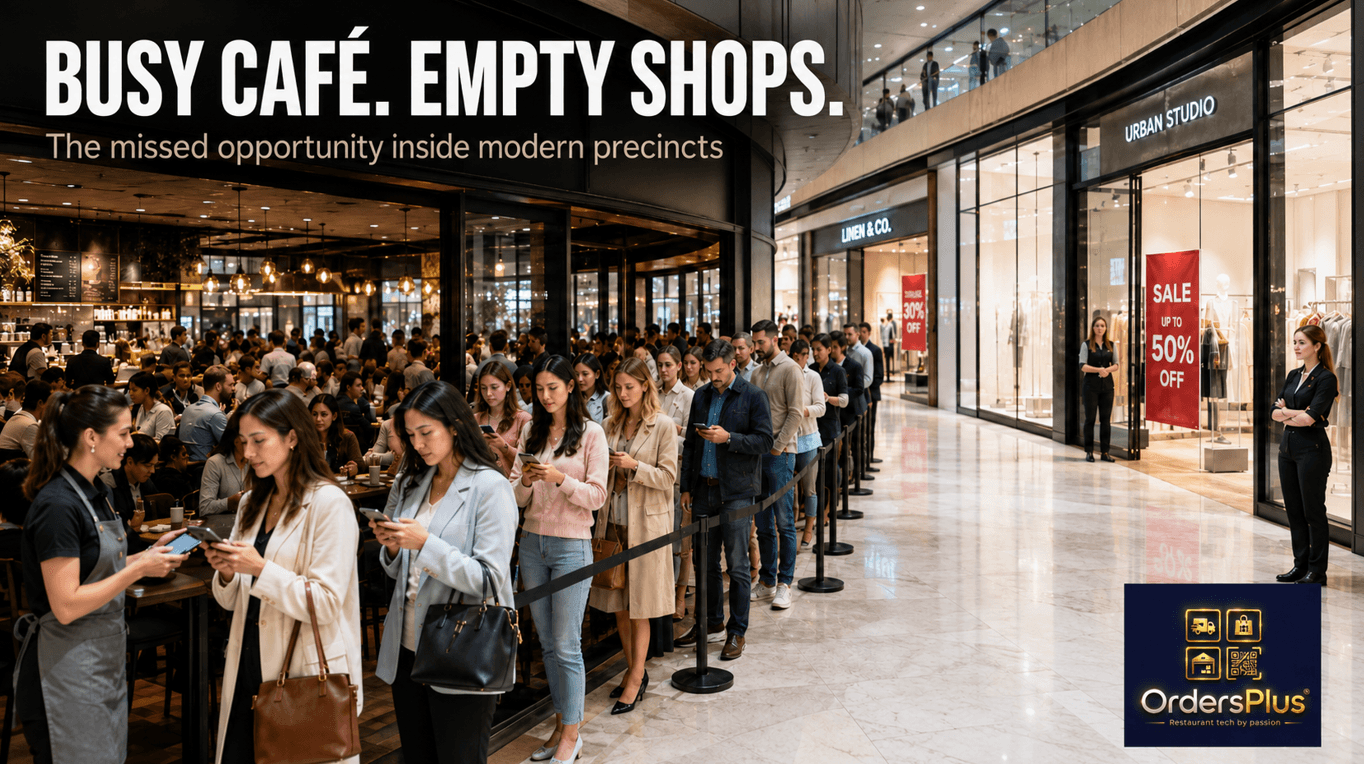
A Busy Café, A Long Queue, and Empty Shops Nearby
My wife and her best friend caught up for brunch at a well-known café inside a shopping centre on Saturday.
The café was packed.
The queue for a table was long.
People were waiting patiently at the front of the café, chatting, looking around, or scrolling through their phones. Some were checking messages. Some were simply standing there with nothing meaningful to do.
Meanwhile, only a short distance away, several retail outlets were quiet.
Some had large discount signs hanging on the shopfront.
Some had sale posters on the windows.
Some had seasonal promotions clearly displayed.
But the people waiting in the café queue were not engaging with them.
Not because they had no interest.
Not because they had no money to spend.
Not because the offers were poor.
They simply could not leave the queue.
And here is the more important question:
How many sales opportunities were missed in that moment?
The Customer Was Already There
This is the part many precinct operators should think carefully about.
The customer was already inside the centre.
They had already made the trip.
They had already parked the car, walked through the doors, and chosen to spend part of their Saturday in that precinct.
This is not cold traffic.
This is not online advertising trying to attract someone from outside.
This is a live, present, high-intent customer already inside the physical retail environment.
And yet, during that waiting period, the customer journey was effectively paused.
- The café had a queue.
- The customer had idle time.
- Nearby retailers had promotions.
But there was no intelligent connection between them.
That is the gap!
The Queue Should Not Be a Dead Zone
In a modern precinct, a café queue should not only be managed by a staff member with a clipboard, a paper list, or a quick verbal promise of “about 20 minutes.”
That model belongs to the old world.
A simple digital queue system could allow customers to scan a QR code, join the waiting list, enter their name and phone number, and receive a notification when their table is ready.
Even better, if the customer already uses the centre app, the process could be faster.
They could join the café queue through the app, receive updates, and move freely around the centre while they wait.
At that point, the customer is no longer trapped at the café entrance.
They are released back into the precinct.
And this is where the commercial opportunity begins.
From Waiting Time to Shopping Time
Once customers are no longer physically tied to the queue, the centre can guide them intelligently.
Nearby retailers can promote relevant offers through the centre app.
- A fashion retailer can show a flash sale.
- A beauty store can promote a limited-time member offer.
- A children’s store can advertise a weekend bundle.
- A gift shop can highlight a discount for customers dining nearby.
- A supermarket or fresh food retailer can promote a “pick up after brunch” offer.
The key is not to spam every customer with every promotion.
That would be lazy technology.
The key is to use context.
- Where is the customer?
- What are they waiting for?
- How long is the estimated wait?
- What categories have they shown interest in?
- What nearby offers are relevant?
- What promotions are time-sensitive?
That is where a centre app becomes more than a digital directory.
It becomes an active commercial engine.
The Café Benefits Too
This is not only good for retailers. It is also good for the café.
A digital waiting system can reduce the pressure on staff.
Instead of having one person constantly managing the queue, answering the same question, and trying to remember who came first, the café can manage the process through a simple dashboard.
When a table is ready, the staff click a button.
The customer receives an SMS or app notification.
The result is cleaner communication, better customer experience, and less pressure at the front of house.
- The café still gets the customer.
- The customer gets more freedom.
- The centre gets more movement.
- Nearby tenants get more exposure.
Everybody wins.
That is what a good precinct system should do.
Promotions Are Useless If Customers Do Not See Them at the Right Time
Many retailers already spend money on promotions.
- They design posters.
- They print signs.
- They dress up shop windows.
- They create discount offers.
- They run weekend campaigns.
But the old assumption is that customers will notice those offers only when they walk past the shop.
That is a weak strategy.
In many cases, customers only discover a discount after they have already entered the store.
But what made them enter in the first place?
That is the missing link.
A promotion should not simply wait passively on a shop window.
A promotion should be discoverable at the right moment, by the right customer, in the right context.
The customer waiting for brunch may not be thinking about shopping yet.
But if a relevant offer appears while they are waiting, the idea is planted.
During brunch, they may talk about it.
After coffee, they may decide to visit the store.
A single-purpose visit becomes a multi-tenant journey.
That is how modern precincts can increase sales without needing more foot traffic.
They can convert the traffic they already have.
The Bigger Picture: Precincts Are Not Just Landlords
This is where the role of precinct management is changing.
In the past, a shopping centre operator could focus on leasing space, maintaining facilities, attracting anchor tenants, and ensuring strong foot traffic.
Those things still matter.
They always will.
But today, foot traffic alone is not enough.
- A centre can be full, while individual tenants still struggle.
- A café can be packed, while nearby retailers sit almost empty.
- A customer can spend two hours in the precinct but can transact with only one tenant.
That is not a lack of foot traffic.
That is a lack of journey orchestration.
Modern precinct management needs to think beyond tenancy mix and physical movement.
It needs to consider digital connectivity, customer intent, offer visibility, and cross-tenant conversion.
From One Visit to Many Opportunities
A customer may enter the centre for one reason:
- Catching up with family and friends for breakfast, Brunch
- To watch a movie.
- Groceries shopping.
- Entertaining their kids.
- A medical appointment.
- A bank visit.
- A quick coffee.
But a well-designed precinct ecosystem should not let the journey stop there.
It should ask:
- What else could be relevant to this customer?
- Which tenants nearby could benefit from this visit?
- Which offers should be surfaced?
- Which customer moments are currently being wasted?
- Which queues, waiting periods, booking flows, and dwell times can be converted into commercial opportunities?
Because in a large retail precinct, opportunities are rarely lacking.
It is usually disconnected.
The Intelligent Precinct Is the Next Frontier
This is where intelligent systems can change the economics of a retail precinct.
A connected precinct platform can bring together:
- Digital queue management
- Centre app engagement
- Tenant promotions
- Customer segmentation
- Location-based offers
- Time-sensitive campaigns
- SMS and app notifications
- Customer journey analytics
- Cross-tenant referral opportunities
- Real-time campaign performance
This is not about replacing the physical shopping centre experience.
It is about strengthening it.
The physical centre already has the atmosphere, dining, entertainment, retail, and social experience.
The missing layer is intelligence.
When that layer is added, a café queue is no longer just a queue.
It becomes a customer engagement channel.
A brunch visit is no longer just a meal.
It becomes the beginning of a broader retail journey.
A discount sign is no longer waiting passively on a window.
It becomes a timely invitation delivered to a customer who is already nearby, already engaged, and already in the mood to spend.
The Question for Precinct Leaders
So the question is no longer simply:
How many people visited the centre today?
The better question is:
How many customer journeys did we activate after they arrived?
The future of retail precincts will not be won by centres with the most impressive buildings, better dining precincts, or the strongest anchor tenants alone.
It will be won by the operators who can connect customer attention to a tenant opportunity.
- The crowd is already there.
- The offers are already there.
- The spending intent is already there.
The question is whether the precinct has the system to bring them together.
Explore the OrdersPlus Precinct Ecosystem.