


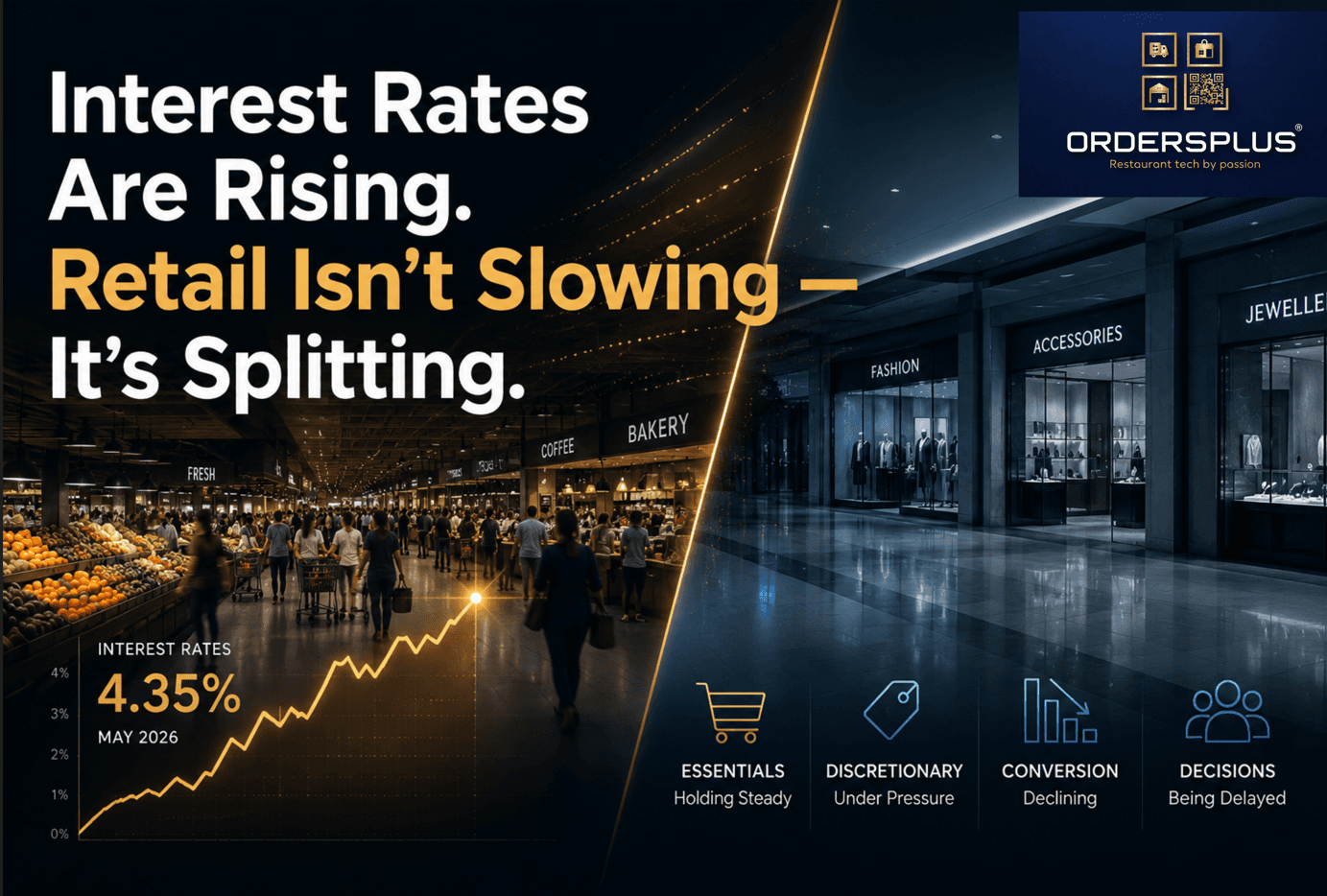
Interest Rates Are Rising. Retail Isn’t Slowing — It’s Splitting.
Interest rates are rising.
Fuel costs remain elevated.
Geopolitical instability continues to weigh on consumer sentiment.
Across the market, the assumption is simple:
Retail is slowing down.
But that’s not what’s actually happening.
The Reality: Retail Is Not Contracting. It’s Diverging.
Recent industry data and market observations are pointing to a more nuanced shift:
Retail activity is not declining uniformly.
It is splitting.
At a recent visit to a major shopping centre, the pattern was clear:
- Ground floor — supermarket, fresh food, takeaway: high foot traffic
- Upper levels — fashion, premium retail, discretionary categories: significantly reduced traffic
Not marginally lower.
Materially lower.
What This Signals
This is not a traffic problem.
It is a shift in spending behaviour under pressure.
Consumers are still visiting centres. But they are changing how and where they spend.
- Essential spending remains stable.
- Discretionary spending is being deferred.
- Basket size is tightening.
- Decision cycles are lengthening.
The Structural Impact on Precincts
For shopping centres and asset managers, this creates a critical disconnect:
Foot traffic remains visible.
But revenue performance becomes uneven.
And in many cases:
- Premium tenants underperform
- Leasing risk increases on upper levels
- Category imbalance begins to emerge
- Marketing effectiveness becomes harder to measure
The Hidden Risk: Misreading the Signal
Most centres are still measuring success through:
- Foot traffic
- Campaign engagement
- Event participation
But in the current environment, these are no longer sufficient indicators of performance.
Because they do not answer the one question that matters:
What is actually converting into revenue?
The Real Problem: Conversion Visibility
What rising interest rates are doing is not just reducing spending.
They are exposing a deeper issue:
A lack of visibility between traffic, tenant activity, and revenue outcomes.
Centres today can track:
- How many people visit
- Which campaigns are running
- Which tenants are present
But they cannot clearly see:
- Which visits lead to transactions
- Which tenants are converting
- Which campaigns are driving revenue
- How spending behaviour is shifting across the precinct
The Shift: From Traffic Management to Revenue Intelligence
In a growth environment, this gap can be tolerated.
In the current market, it cannot.
The focus is shifting from:
- Driving foot traffic
- Managing tenant mix
To:
- Understanding conversion
- Measuring real performance
- Optimising revenue across the precinct
Where This Leads
The centres that adapt fastest will not be those that simply attract more visitors.
They will be those who can answer, in real time:
- Where revenue is being generated
- Where revenue is being lost
- How customer behaviour is changing
- How tenants are actually performing
How Orders Plus Is Responding
We are currently working with shopping centre operators to map this at a precinct level — connecting:
- Foot traffic
- Tenant activity
- Campaign performance
- Revenue outcomes
Into a single, measurable system.
If this shift resonates with what you are seeing on the ground:
It may be time to look beyond traffic — and start measuring what actually drives performance.
Explore the Precinct Revenue Intelligence Framework
If your centre is currently experiencing shifting customer behaviour, uneven tenant performance, or reduced visibility into conversions, we invite you to explore how leading precinct operators are approaching the next phase of retail intelligence.