


Franchise Growth Is Not the Hard Part. Operational Control Is.
Most franchise groups think expansion is about opening more stores.
But it isn’t.
The real challenge begins when labour costs outpace operational visibility.
Most QSR franchise groups today rely heavily on POS reporting.
They track:
- Total sales
- Best-selling items
- Discounted deals
- Payment types
- Membership account activities
- Transaction volume
And while this data is useful, it only tells part of the story.
Because sales data tells you what was sold.
It does not tell you whether the operation was efficient.
That is the real problem.
A store can produce strong sales numbers while quietly eroding margins due to poor labour allocation, inconsistent staffing decisions, and operational inefficiencies hidden beneath the surface.
And in most franchise environments, this problem compounds as the network grows.
The Labour Cost Blind Spot
The majority of QSR labour today is casual labour.
Staff are typically rostered around “busy periods.”
But busy based on what measurement?
- Manager instinct?
- Past experience?
- Guesswork?
- General assumptions about lunch and dinner rushes?
In many cases, yes.
Because most franchise groups still lack visibility into the relationship between:
- Trading rhythm
- Sales timing
- Labour allocation
- Operational performance
This is where operational control begins breaking down.
The head office may receive weekly sales reports, but without understanding:
- What time did the sales occur
- How labour was deployed during those periods
- How peak-hour staffing compares against revenue generated
- How stores performed during slower trading windows
They are effectively managing blind.
When Labour Becomes a Margin Problem
Labour is no longer a small operational issue.
It is one of the largest cost pressures facing the entire QSR industry.
Overstaffing destroys margins.
Understaffing slows service, degrades the customer experience, disrupts kitchen flow, and undermines staff morale.
The danger is that most franchise groups only discover the problem after operational performance has already deteriorated.
The Problem with Fragmented Systems
The market clearly recognises this challenge.
Platforms like Deputy, Tanda, 7shifts, and UKG have emerged to address the complexity of workforce management and rostering across hospitality and retail environments.
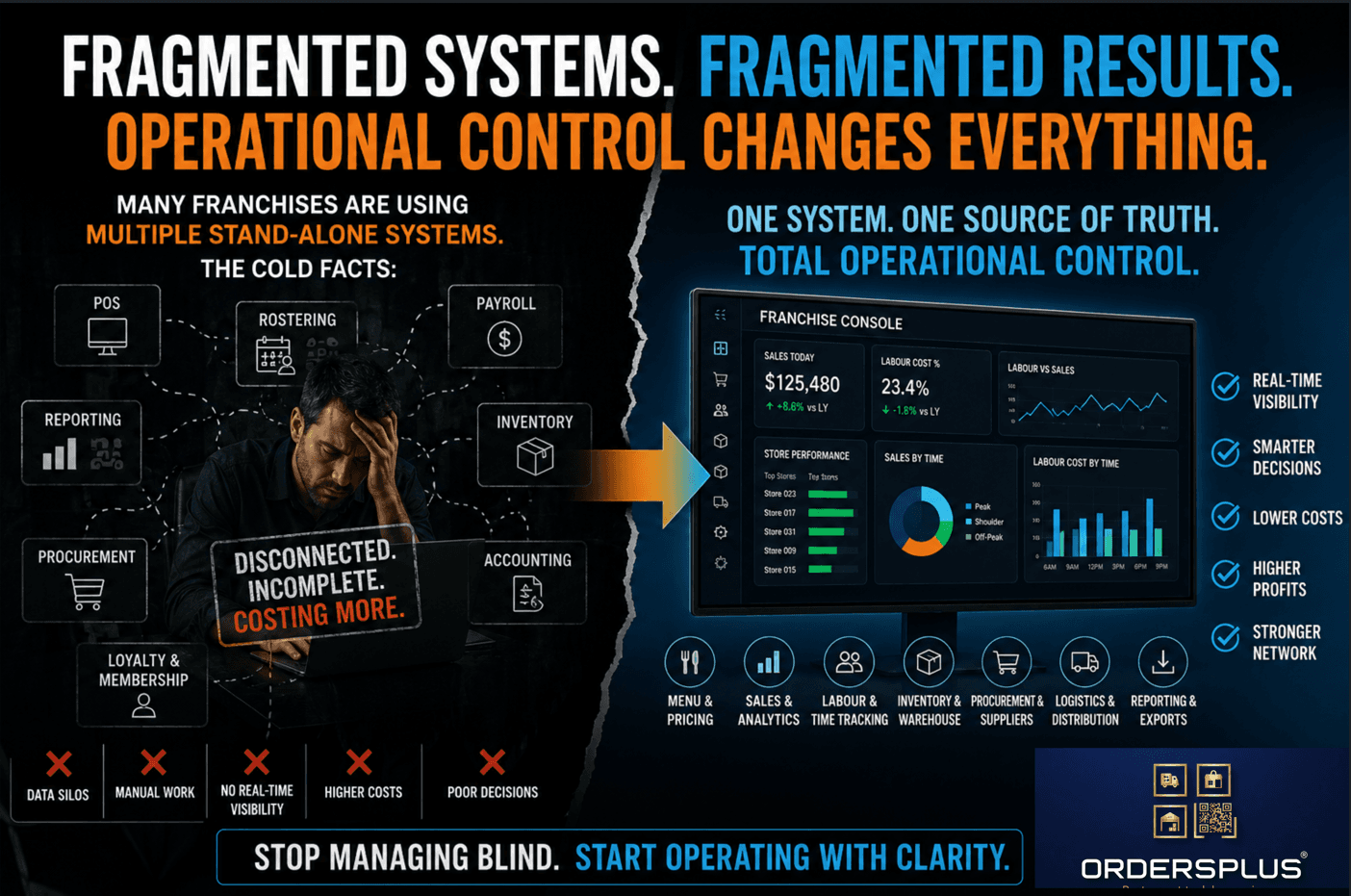
But even then, many franchise groups still operate fragmented systems:
- POS in one platform
- Rostering in another
- Payroll somewhere else
- Operational reporting somewhere else again
Every additional integration introduces:
- More cost
- More complexity
- More operational separation
This is the hidden structural problem modern franchise groups are now facing.
Operational intelligence cannot exist when operational data is fragmented across disconnected systems.
What Future Franchise Operations Actually Need
The future franchise environment requires something fundamentally different.
Not another standalone platform.
But a unified operational intelligence infrastructure capable of providing a dynamic operational view across the entire franchise network.
This means connecting:
- Menu and pricing management
- Sales and transaction timing
- Labour allocation and time tracking
- Membership and customer activity
- Internal product distribution
- External procurement
- Warehouse operations
- Logistics and supply chain management
All under one system.
One operational layer.
One source of visibility.
Because once operational data becomes unified, franchise groups gain the ability to:
- Extract operational intelligence across locations
- Analyse trading rhythm patterns
- Correlate labour cost against revenue timing
- Identify operational inefficiencies
- Make faster, strategic decisions based on real operational behaviour rather than assumptions
That is the difference between simply collecting sales data and actually understanding operational performance.
As a result, many franchise operators today still cannot clearly correlate labour costs against actual trading behaviour across their networks in real time.
And that is the operational blind spot most franchise groups are now facing.
Operational Intelligence Is the New Franchise Advantage
The future of franchise operations will not be decided by who opens the most stores.
It will be decided by who best understands operational timing, labour efficiency, and trading rhythm.
Because sales alone do not build profitable franchise networks.
Operational intelligence does.