

Every hospitality business needs a POS system.
That is not the debate.
Whether it is a small café, a quick-service restaurant, a full-service dining venue, or a national franchise network, the POS is one of the most basic operating tools in the business. It records sales, processes payments, manages transactions, supports daily reporting, and gives the store operator a clear record of what happened at the counter.
Without a POS, the store cannot operate properly.
But in the franchise sector, the bigger question is not whether the business needs a POS.
The bigger question is:
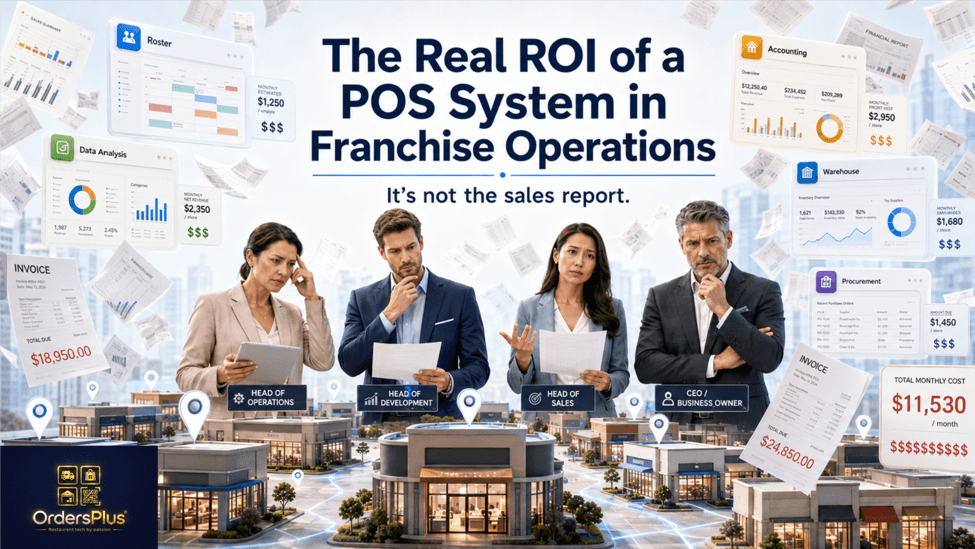
What return does the franchise group actually receive from the POS beyond basic transaction processing?
This is where the conversation becomes more serious.
For a local store, a POS report may be enough to answer a simple question:
“What did we sell today?”
But for a franchisor, that question is only the beginning.
A franchise head office needs to understand something much deeper:
- Did the campaign bring in new customers?
- Did new patrons spend more or less than existing customers?
- Did the promotion increase total sales but reduce average spend?
- Did regular customers change their buying behaviour during the promotion?
- Did labour costs rise faster than sales?
- Did the promotion create real commercial value, or did it simply generate busy stores with weaker margins?
These are not simple sales-report questions.
These are franchise ROI questions.
A POS Tells You What Was Sold. It Does Not Always Tell You What Was Gained.
Traditional POS systems were built around the transaction.
That is their core purpose.
They record what was ordered, when it was sold, how it was paid for, which staff member processed it, and which store completed the transaction.
That information is useful. In fact, it is essential.
But transaction data alone does not automatically indicate whether the franchise group is becoming more profitable, more efficient, or more scalable.
For example, a promotion may increase sales by 20%.
On the surface, that looks like success.
But what if most of those sales came from discount-driven customers who did not return?
What if the average spend from regular customers dropped because they used the promotion rather than paying the regular price?
What if labour hours increased by 30% to support the campaign?
What if kitchen pressure increased, service speed slowed, and the store needed more staff to produce a lower-margin result?
What if franchisees were busier, but not actually more profitable?
This is the real issue.
Sales growth does not automatically mean commercial success.
A busy store is not always a healthy store.
Franchise ROI Needs Customer Intelligence, Not Just Sales Totals.
For a franchisor, campaign performance cannot be judged solely by sales.
A promotion may increase revenue, but head office needs to know whether it created real, profitable growth.
- Did it attract new patrons, or was it simply a discount for existing customers?
- Did new customers spend at a healthy level, and did they return after the campaign?
- Did regular customers spend more, or did they only take advantage of a lower price?
- Which locations converted campaign traffic well, and which stores relied too heavily on discounting?
These questions matter because franchise growth must be repeatable, not accidental.
A campaign that creates one-off discount traffic may look good on a sales report, but it may not create long-term value.
The franchisor also needs to understand the cost behind the sales: discount value, labour increase, extra staff hours, and any impact on customer experience.
Without this view, the business is not measuring ROI.
It is only measuring activity.
And in franchise operations, that can be dangerous.
A promotion that fills one store but weakens margin is a local issue.
A promotion that does the same thing across the network becomes a franchise problem.
Labour Cost Is Where Promotion ROI Often Breaks Down.
Labour is one of the most important cost areas in hospitality.
During a promotion, labour pressure usually increases.
More orders need to be taken. More food needs to be prepared. More customers need to be served.
More cleaning, packing, delivery handling, and front-of-house coordination may be required.
If labour cost rises in line with profitable sales growth, that may be acceptable.
But if labour costs rise faster than revenue, the promotion may be damaging the margin.
This is why the franchise head office needs to understand:
- What was the labour cost as a percentage of sales before the promotion?
- What did it become during the promotion?
- Which locations handled the extra demand efficiently?
- Which locations were overstaffed?
- Which locations were understaffed and damaged service quality?
- Did the campaign create profitable growth, or simply add labour pressure?
This cannot be answered properly if the POS data sits in one system and the rostering data sits in another.
The franchisor may have sales reports from the POS.
The franchisee may have rosters in a workforce system.
- Finance may have wage data after payroll.
- Marketing may have campaign results.
But if these systems are disconnected, the real ROI picture arrives late, incomplete, or manually assembled.
By then, the campaign is already over.
The Problem Is Not Only the POS Cost. It Is the Architecture Behind the POS.
Many traditional POS systems were originally built for local store operations.
Their first job was to process transactions, print receipts, manage tills, send orders to the kitchen, support payment processing, and produce end-of-day reports for the venue operator.
That model worked well for individual stores.
But franchise operations require a different level of visibility.
A franchisor does not simply need to know what happened at one outlet yesterday. It needs to understand what is happening across the network, how each location is performing, how promotions are affecting customer behaviour, whether labour cost is rising faster than sales, and whether store-level activity is creating real commercial value.
This is where older POS architecture can become a limitation.
Many legacy or on-premise POS systems were not originally designed to operate as a live franchise intelligence layer. To support centralised reporting, labour analysis, campaign tracking, customer analytics, and network-level performance comparison, they often require additional back-office modules, cloud dashboards, middleware, third-party integrations, manual exports, or business intelligence tools.
In many cases, the store continues to operate well at the transaction level.
But the network becomes harder to control at the head office level.
Each outlet can easily become a data island:
- The store may know what it sold.
- The POS provider may provide a report.
- The rostering system may show labour hours.
- The accounting system may show financial results later.
- The marketing platform may show campaign activity.
But the franchisor still has to connect the picture manually.
That is not franchise intelligence. That is data collection.
And there is a big difference between the two.
Cloud Reporting Helps, But It Does Not Automatically Solve Franchise ROI.
Modern POS providers have responded to market demand by adding cloud reporting, multi-location dashboards, analytics modules, and head-office visibility.
This is useful. In many cases, it is necessary.
But cloud reporting alone does not solve the full franchise ROI problem.
The key issue is not simply whether the POS data can be sent to the cloud.
The real issue is whether the data can be converted into operational intelligence.
A centralised sales report may tell head office what each outlet sold.
But franchise ROI requires more than that.
It requires the ability to connect sales performance to customer acquisition, repeat visits, average spend, promotional costs, labour pressure, product margins, procurement behaviour, and franchisee support.
This is where many POS systems still face a structural limitation.
Their centre of gravity is still the transaction. They are built to record sales first.
Franchise groups need a wider operating layer that understands how sales connect with the rest of the business.
That distinction matters.
Once a franchise network grows, the question is no longer only:
“What did each store sell?”
The better question is:
“Which stores are creating profitable, repeatable, and scalable growth?”
That answer requires more than cloud-based sales reporting.
The Centralised POS Report Was Not Originally the Core of the POS Model.
Many POS providers now offer multi-location reporting, dashboards, analytics, and centralised visibility.
Again, this is useful.
But it is important to understand the category’s history.
The traditional POS system was not originally designed as a franchise command platform.
It was designed to process transactions at the store level.
As franchise groups, hospitality groups, and multi-location operators became more demanding, POS providers added centralised reporting features to meet market needs.
That does not make those features useless.
But it does mean the centre of gravity is still the store transaction.
The POS sees the sale. It does not always understand the whole commercial equation behind the sale.
Franchise ROI requires a wider view. It needs to connect sales, labour, customer behaviour, menu performance, promotional costs, procurement, supplier pricing, franchisee performance, and head-office decision-making.
That is not simply a POS problem.
That is an operating infrastructure problem.
The Hidden Cost Is Not the POS. It Is Turning Data Into Intelligence.
The basic POS subscription is often only the starting point.
For the franchise head office to understand the network’s true performance, sales data alone is not enough. It needs to be connected to labour, rostering, payroll, accounting, customer behaviour, promotional activities, inventory, and supplier costs.
This is where the hidden cost begins.
The franchisor may first need to subscribe to separate platforms for rostering, workforce management, accounting, loyalty, customer engagement, and reporting.
Then comes the next cost: system integration.
Each platform may hold an important part of the picture, but those systems do not automatically speak the same language. To bring the data together, the franchisor often needs custom integration work, API connections, consultants, technical support, or internal staff to manage the process.
After that, the business may still need a data analysis or business intelligence platform, such as Tableau, to combine the information into a single view that the head office can use.
By this point, the real cost is no longer just the POS subscription.
It is the full software stack around the POS.
The franchisor may be paying one provider for sales reports, another for rostering, another for accounting, another for loyalty, another for integrations, and another for data visualisation.
Even then, the result may still be rigid, delayed, and difficult to adjust when the business changes.
This is the problem with disconnected systems.
Each platform may report its own version of the truth.
But the franchise head office needs a single, connected view of the operation — not five separate reports that still require someone to manually interpret their meaning.
Expensive Reports Do Not Automatically Create Better Decisions.
This is where ROI needs to be judged properly.
The real ROI question is not:
“How many reports can the POS generate?”
It is:
“What decisions can the franchise group make because of those reports?”
There is a major difference.
A system may generate beautiful dashboards.
It may show sales by outlet, product, staff member, payment method, time period, and order channel.
It may even compare stores across the network.
But if those reports do not help the franchisor understand margin, labour pressure, campaign quality, customer behaviour, and franchisee performance, then the commercial value remains limited.
- A report has no value unless it improves a decision.
- A dashboard has no value unless it helps the operator act sooner.
- A centralised view has no value unless it gives head office better control of the network.
Franchise groups do not need more information for their own sake.
They need information that changes the way the business is managed.
The Real ROI Question
The real ROI question is not:
“How much does the POS cost?”
That is too narrow.
The real question is:
“What decisions can the franchise group make because of the information the system provides?”
A good franchise operating system should help the head office understand:
- Which campaigns create profitable new customer growth?
- Which locations are converting demand efficiently?
- Which stores are relying too heavily on discounts?
- Which franchisees are carrying unnecessary labour costs?
- Which products generate sales but weaken the margin?
- Which menu items drive repeat customers?
- Which stores need support before performance declines further?
- Which operational patterns are repeated across the network?
- Which decisions improve franchisee profitability?
This is where ROI becomes real.
Not in the report itself.
But in the decisions the report makes possible.
Franchise Groups Need a Command Layer, Not Just More Reports.
The next stage of franchise technology will not be won by the system that produces the most reports.
Most franchise groups already have reports.
The challenge is that many of those reports are fragmented, delayed, or limited to one part of the business.
- The POS reports sales.
- The rostering system reports labour.
- The loyalty system reports customers.
- The accounting system reports financials.
- The inventory system reports stock.
- The BI tool visualises data.
But the franchisor still has to ask:
What does all this mean?
That is the gap.
The franchise head office does not need another isolated dashboard.
It needs a connected command layer that can bring operational data together and convert it into commercial intelligence.
A modern franchise group should be able to see how promotions affect sales, customer behaviour, labour cost, menu performance, and store profitability across the whole network.
- It should be able to compare locations.
- It should be able to identify risk early.
- It should be able to support franchisees with evidence, not assumptions.
- It should be able to make better decisions before cost damage becomes obvious.
The Future of Franchise ROI
A POS system will always be necessary. It is the foundation of store transactions.
But in franchise operations, the POS should not be confused with the business’s overall operating intelligence.
The franchisor needs more than a record of what each store sold.
It needs to understand whether each store is becoming more efficient, more profitable, and more scalable.
That requires a broader system view.
One that connects sales, labour, ordering, procurement, customer behaviour, promotions, payments, and franchisee performance.
The future of franchise growth will not be decided solely by how many stores are opened.
It will be decided by how well the franchisor understands what is happening inside the network.
A POS can tell you what was sold.
A franchise command layer should tell you whether the business is truly growing.
That is where the real ROI begins.