


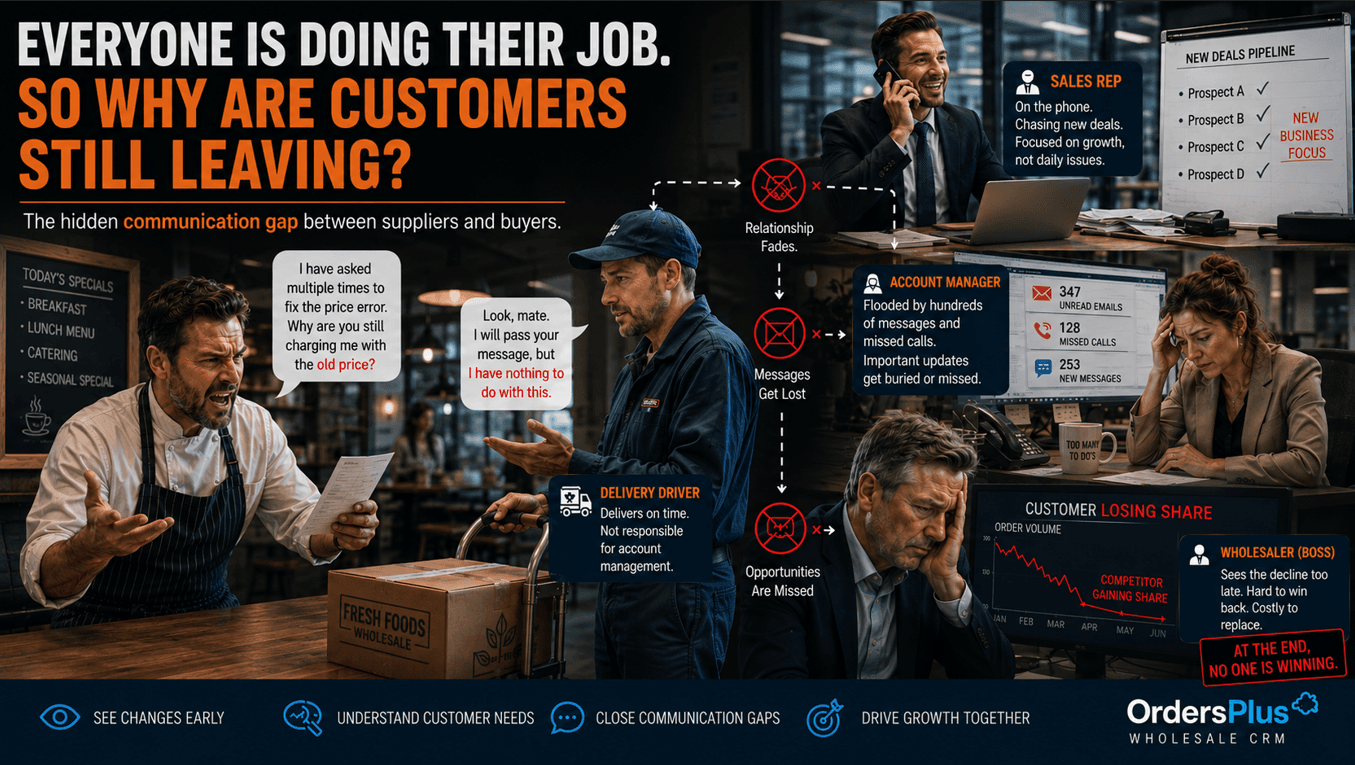
Everyone Is Doing Their Job, So Why Are Customers Still Leaving?
In our previous article, we explored the hidden cost of customer acquisition in the wholesale industry.
Sales representatives spend months building relationships, negotiating pricing, providing samples, arranging credit terms, and earning a buyer's trust. By the time a new account is activated, the business may have invested thousands of dollars before generating any meaningful return.
The question is simple:
How long must that customer stay before the acquisition cost is recovered?
For many wholesalers, winning the account is not the finish line.
It is only the beginning.
The Challenge Begins After the First Order
During the sales process, the supplier learns a great deal about the buyer:
- What products do they purchase
- Which brands do they prefer
- Their pricing expectations
- Their delivery requirements
- Their growth plans
- Their seasonal demand patterns
This information helps secure the account.
However, once the customer is onboarded, the relationship often shifts from the sales representative to an account manager, customer service team, or operations department.
The original understanding of the customer remains frozen in time while the customer's business continues to evolve.
And that is where the risk begins.
Customers Change Faster Than Suppliers Realise
Consider a café that originally focused on breakfast trade.
A few months later, the same business may have expanded into lunch service, catering, seasonal specials, or premium product offerings.
- Its menu changes.
- Its purchasing priorities change.
- Its margins come under different pressures.
- Its product requirements evolve.
The supplier may continue delivering exactly what was originally requested while completely missing what the customer needs today.
Not because the service failed.
Not because the relationship broke down.
But because nobody noticed the change.
The Silent Loss of a Customer
Most buyers do not announce that they are looking elsewhere.
That is where competitors come in.
When menu items change or purchasing priorities shift, buyers begin exploring alternatives.
- They speak to other suppliers during the first approach visit.
- They request better pricing on other items.
- They compare product ranges.
- They look for new ways to improve profitability.
By the time order volumes begin to decline, conversations with competitors may already have been underway for weeks or even months.
The warning signs were there.
Nobody could see them.
When Communication Starts Breaking Down
In many wholesale businesses, buyers rarely communicate directly with the salesperson who originally won the account.
- Account managers are responsible for dozens of customers.
- Sales representatives are focused on winning new business.
- Operations teams are busy managing fulfilment and deliveries.
As a result, buyers often communicate through the person they see most frequently:
The delivery driver.
Important customer information may be shared during deliveries, including:
- A request for alternative products
- A question about pricing
- A new menu launch
- Expansion plans
- Concerns about product quality
This information is often shared with the expectation that it will reach the right person.
Sometimes it does.
Sometimes it doesn't.
The problem is not the driver.
Drivers are responsible for delivering products, not managing customer relationships. They often try to help, but this is clearly not their core responsibility, nor is it where their role is designed to create value.
When messages are delayed, forgotten, or misunderstood, frustration builds.
The buyer believes they have communicated their needs.
The supplier believes no request was ever made.
Neither side intended for the relationship to weaken.
Yet another gap has opened between supplier and customer.
And every communication gap creates an opportunity for a competitor to step in.
Customer Retention Is an Intelligence Problem
The challenge is not a lack of effort.
- Sales teams are focused on growth.
- Account managers are managing large customer portfolios.
- Operations teams are focused on fulfilment.
- Finance teams are managing payments and credit risk.
No individual can continuously monitor every customer's changing business needs.
Nor is it realistic to expect buyers to regularly update suppliers on every menu change, promotion, or business initiative.
This creates an information gap between the supplier and customer.
And that gap continues to widen as the relationship matures.
Most wholesalers lose visibility long before they lose the customer.
The Missing Layer Between Supplier and Buyer
This is where the next generation of wholesale CRM becomes important.
Traditional CRM systems record customer information, sales activities, and account history.
Modern CRM platforms should do much more.
- They should help wholesalers understand how customers are evolving.
- They should identify changes in buying patterns.
- They should highlight emerging opportunities.
- They should surface communication gaps.
- They should detect risks before orders stop arriving.
Most importantly, they should help account managers focus their attention where it matters most.
Because by the time a customer stops ordering, it is often too late.
The Future of Customer Retention
The wholesalers that thrive over the next decade will not necessarily be the ones with the largest sales teams or the lowest prices.
They will be the ones who understand their customers better than their competitors do.
This is one of the key principles behind the OrdersPlus Wholesale CRM.
Designed as an extension of traditional sales CRM, the platform aims to bridge the information gap between suppliers and buyers by providing greater visibility into customer behaviour, purchasing trends, communication activity, and operational opportunities.
Because customer retention is not simply about maintaining relationships.
It is about continuously understanding the businesses behind those relationships.
And the moment a supplier stops understanding a customer, a competitor begins to.
Share your thoughts or speak to our product specialist.