


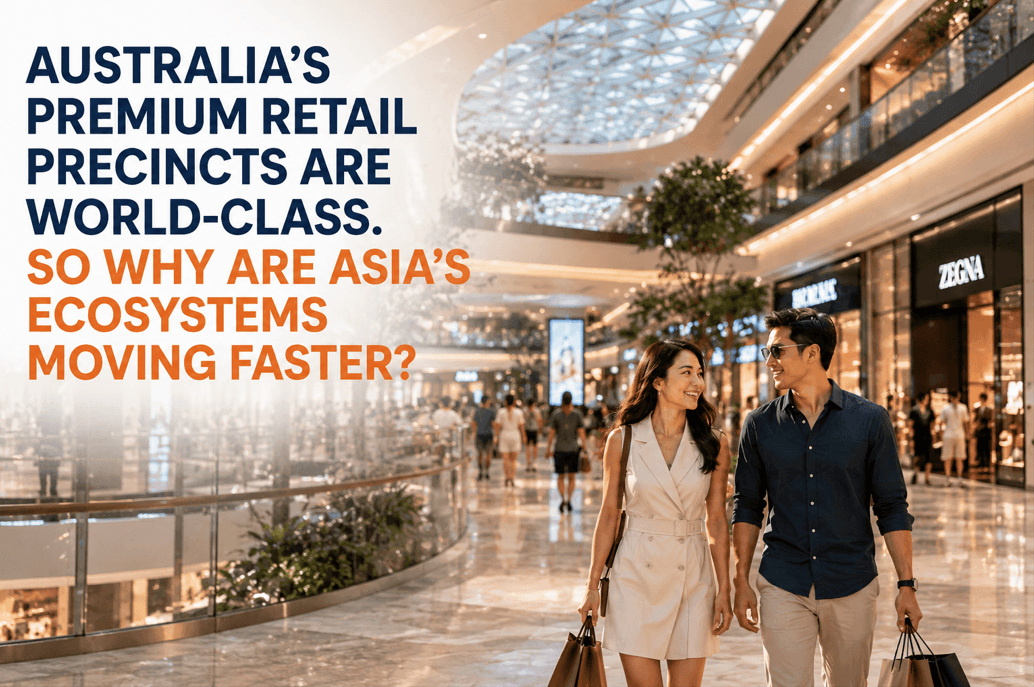
Australia's Premium Retail Precincts Are World-Class.
So Why Are Asia's Ecosystems Moving Faster?
Over the past few months, I have spent considerable time visiting major retail precincts across Sydney and examining how shopping centres are evolving in response to changing consumer expectations.
The investment in premium retail experiences is undeniable.
Centres are undergoing significant redevelopment. New luxury brands are arriving. Dining precincts are expanding. Public spaces are becoming more engaging. The physical environment continues to improve.
Across Sydney and many other major Australian cities, retail precincts appear to be moving in two very different directions.
In locations such as Chatswood, Macquarie Park, Parramatta, Hurstville, and the Sydney CBD, major retail groups are investing heavily to reposition their assets as premium destinations. Significant capital is being deployed into redevelopment projects, luxury retail brands, flagship dining experiences, entertainment offerings, and enhanced customer environments.
The objective is clear: attract higher-spending consumers, strengthen tenant demand, and increase the asset's long-term value.
At the same time, many traditional shopping centres continue to operate successfully as convenience-focused precincts, serving local communities through supermarkets, fresh food retailers, bakeries, butchers, pharmacies, and everyday services.
Neither model is inherently right or wrong.
However, the gap between these two groups is becoming increasingly visible.
The most interesting observation is that while premium precincts continue to invest heavily in physical transformation, a new competitive battleground may be emerging beyond the asset itself.
The next stage of competition may not be determined by who builds the most attractive destination.
It may be determined by who builds the most connected ecosystem around it.
Are We Overlooking The Digital Ecosystem?
Yet while observing these developments, I found myself asking a different question.
Are we focusing too heavily on the physical asset while overlooking the digital ecosystem surrounding it?
Looking North: What Asia's Leading Precincts Are Building
Across Hong Kong, Singapore, and Shanghai, some of Asia's most successful retail groups have quietly moved beyond traditional loyalty programs.
They are building integrated customer ecosystems.
Consider The Point by SHKP in Hong Kong.
The platform connects multiple retail destinations under a single customer identity, allowing members to interact with retailers, dining venues, promotions, events, rewards, and services within a single ecosystem.
In Singapore, CapitaStar has expanded far beyond a typical shopping centre rewards program.
Today, it connects multiple precincts, retailers, digital vouchers, promotions, payment experiences, and customer engagement programs across an entire retail network.
Changi Airport and Jewel Changi have taken this even further by integrating shopping, dining, travel experiences, rewards, and digital engagement into a unified customer journey.
These organisations are no longer simply managing shopping centres.
They are operating retail ecosystems.
The Shift From Property Management To Ecosystem Management
Traditionally, shopping centre performance has been measured through:
- Foot traffic
- Occupancy rates
- Retail sales performance
- Leasing outcomes
These metrics remain important.
However, leading precinct operators are increasingly asking a different set of questions:
- How frequently does a customer engage with our precinct?
- Which retailers are generating repeat visitation?
- What customer journeys exist across retail and dining experiences?
- Which promotions drive measurable spending behaviour?
- How can digital engagement influence physical movement throughout the precinct?
The objective is no longer simply attracting visitors.
The objective is to understand, influence, and improve the entire customer journey.
Why This Matters For Australia
Australia's premium retail precincts compete in a market that is increasingly influenced by international consumer expectations.
Many visitors arriving from Singapore, Hong Kong, Mainland China, Korea, and other parts of Asia are already accustomed to highly connected retail ecosystems.
They expect:
- Mobile-first engagement
- Digital rewards
- Personalised offers
- Integrated loyalty experiences
- Frictionless payment options
- Precinct-wide benefits and incentives
For these customers, the shopping centre is no longer just a destination.
It is part of a broader digital experience.
The challenge for Australian precincts is not whether their physical assets are competitive.
Many already are.
The challenge is whether the surrounding digital ecosystem is evolving at the same pace.
The Missing Piece
When discussing the future of retail precincts, conversations often focus on redevelopment, tenant mix, activation campaigns, and customer acquisition.
These initiatives are important.
But increasingly, the missing piece may be the infrastructure that connects them all.
The next generation of precinct performance may not be determined solely by who builds the most attractive destination.
It may be determined by who builds the most connected ecosystem.
Because while customers still visit places, they increasingly engage with platforms.
And the precincts that successfully connect both worlds may hold the strongest competitive advantage in the years ahead.
What Are Your Thoughts?
Are Australia's premium retail precincts evolving fast enough to meet the expectations of the next generation of consumers?